Your Wardrobe is Hiding a Lake's Worth of Water
- Edu Expressions
- Jun 1
- 3 min read
Behind every shirt, every pair of jeans, every car in your driveway lies an invisible ledger of water — consumed during manufacturing, long before the product ever reached you. (Based on data from WWF, Geographical Magazine, Water Footprint Network · Updated June 2026).
Open your wardrobe. Look at what hangs inside. It appears unremarkable — fabric, thread, dye. But behind every garment lies a hidden water bill of staggering proportions, paid not at the checkout counter but at rivers, aquifers, and reservoirs across the world. This is the story of virtual water: the water industry consumes on your behalf, invisibly, before a product ever reaches your hands.

The car in your driveway has already drunk deeply
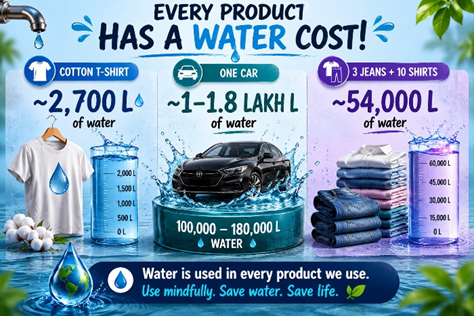
Your car runs on petrol, yet it consumed a vast amount of water before you ever turned the key. Across the full manufacturing supply chain — steel smelting, aluminium processing, rubber production, paint shops, cooling systems — a typical automobile requires somewhere between 1 lakh and 1.8 lakh litres of water to produce. Some estimates, accounting for the entire raw-material supply chain, push that figure even higher. Either way, the number is extraordinary for something we never think of as "using" water at all.
This is not unique to cars. Motorcycles, appliances, electronics — nearly every manufactured product carries what researchers call a "virtual water footprint," the hidden volume of freshwater consumed in its creation. We simply cannot see it. But it is there, drawn from rivers and underground aquifers, often in parts of the world already facing severe water stress.
"Every time you buy a new garment, you are casting a vote for industrial water consumption."
The wardrobe that holds a small reservoir
Cotton — the world's most popular clothing fibre — is one of the most water-intensive crops on earth. Growing, ginning, spinning, weaving, dyeing, and finishing a single piece of clothing draws water at every stage. The numbers, once calculated, become sobering.

Fast fashion, faster depletion
We live in the age of fast fashion. Trends cycle every few weeks. Clothes are bought impulsively, worn a handful of times, and discarded. The fashion industry is now one of the largest consumers of fresh water on the planet — it uses an estimated 93 billion cubic metres annually, enough to meet the needs of five million people. Around 20% of global industrial water pollution comes from textile dyeing and treatment alone.
In countries like Bangladesh, India, and China — where much of the world's clothing is made — rivers near garment factories have turned unnatural colours, carrying synthetic dyes and toxic chemicals into communities that depend on those waterways for survival.
The case for buying less, choosing wisely
None of this is meant to inspire guilt. It is meant to inspire awareness — and action. The power to reduce industrial water consumption does not lie solely with governments or corporations. It lies, in meaningful part, with each of us, every time we reach for our wallets.
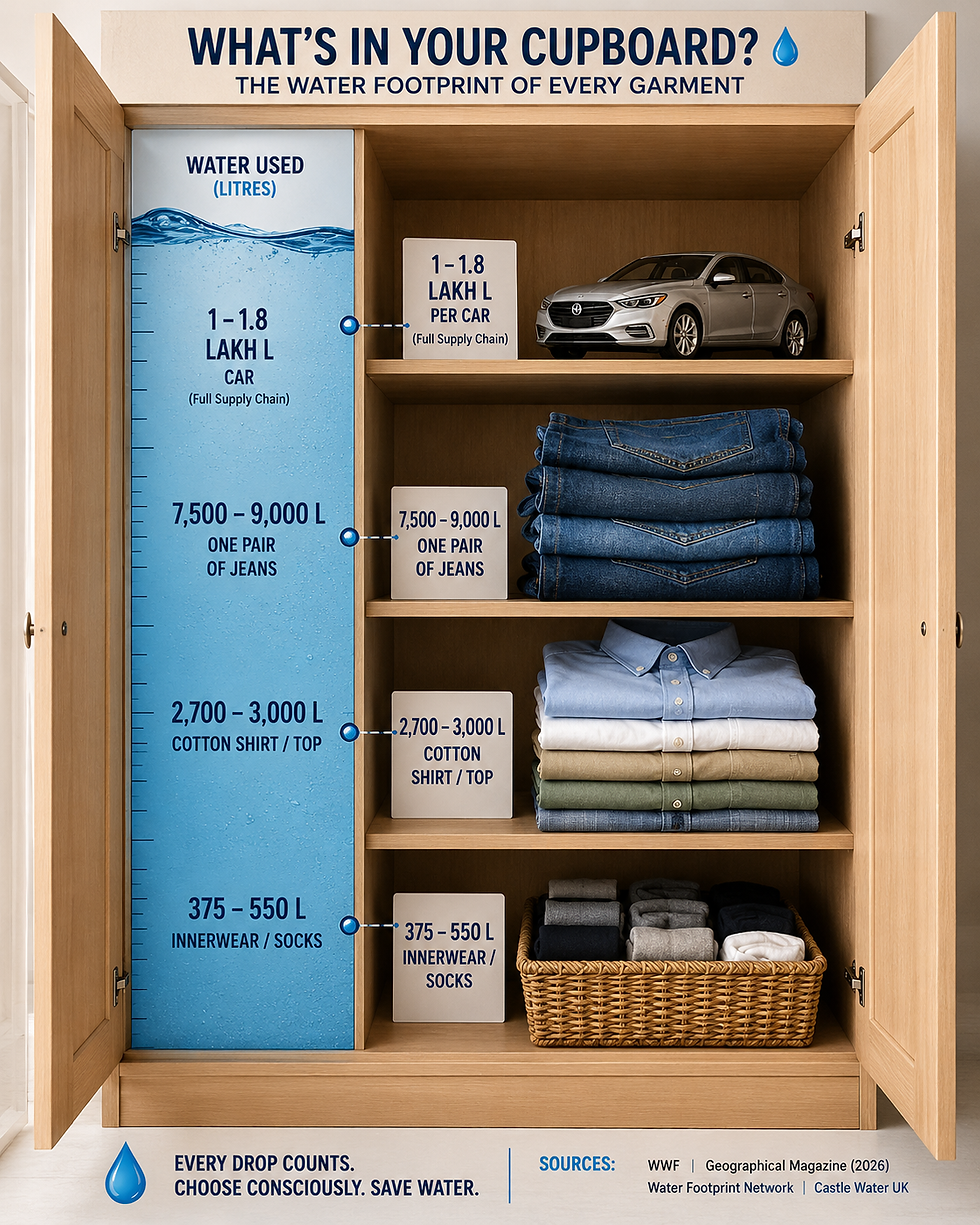
Buying fewer, higher-quality garments that last longer directly reduces your virtual water footprint. Choosing second-hand clothing eliminates the manufacturing water cost entirely. Supporting brands that use organic cotton — which uses up to 91% less "blue" water than conventional cotton — sends a powerful market signal. Even extending a garment's useful life by just three months meaningfully reduces its environmental impact.
The same thinking applies to every manufactured product. Thoughtful, deliberate purchasing is not merely a lifestyle choice. It is a quiet but powerful act of environmental stewardship.
Every purchase is a choice about water
Before you buy, pause. Ask whether you truly need it, whether something you already own could serve the same purpose, and whether a more sustainable option exists. The water you save is not abstract — it sustains rivers, nourishes crops, and keeps communities alive. Buy less. Choose well. Save the planet.


Comments